Terroir Santorini · Sommelier’s Guide
Santorini Wine: Terroir,
Viticulture & Winemaking
A deep dive into the volcanic island that produces some of the world’s most distinctive wines written by the sommeliers who live and work within it.
Santorini is not simply a wine region. It is a geological argument — a place where the conditions are so extreme, so specific, and so irreplicable that the wine it produces cannot exist anywhere else on earth.
If you have tasted a well-made Santorini Assyrtiko and felt that combination of razor acidity, saline minerality, and volcanic intensity, you already understand instinctively why wine professionals speak about this island with a particular reverence. What you may not yet know is the full story behind how that wine arrives in the glass — a story that begins not in a cellar, but in an ash field, thousands of years before modern viticulture existed.
This guide is written by the certified sommeliers at Terroir Santorini who have spent years not only guiding guests through the island’s wine landscape, but studying, tasting, and working within it. Everything here reflects what we consider essential knowledge for anyone who wants to move beyond surface appreciation and into genuine understanding of Santorini wine.
Chapter 01
The Volcanic Terroir of Santorini
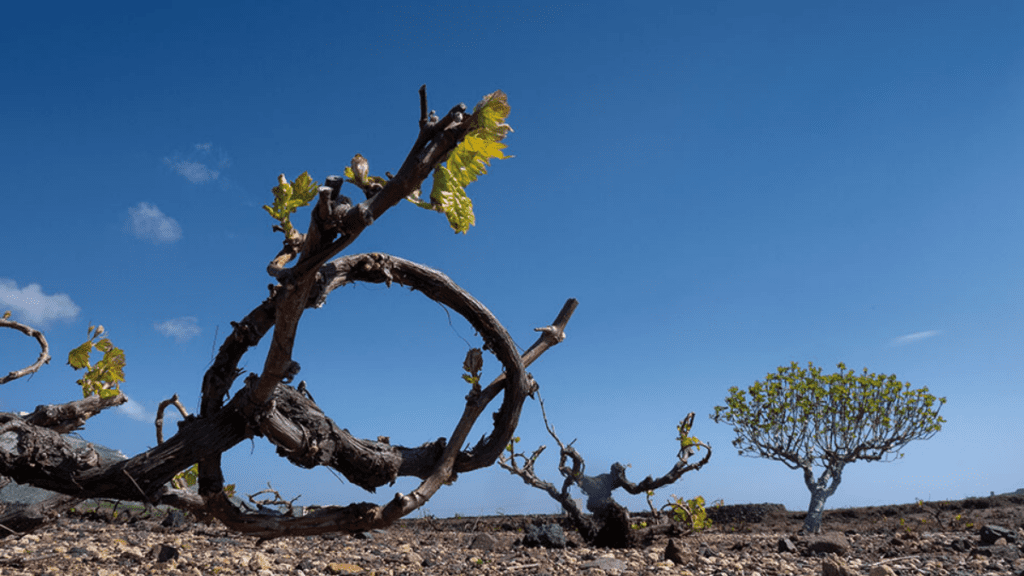
The word terroir is borrowed from French and has no precise equivalent in English, which is perhaps appropriate — the concept itself resists simplification. It describes the complete natural environment of a vineyard: soil, subsoil, climate, topography, and the way these factors interact with the vine. In Santorini, terroir is not a marketing concept. It is the physical reality of every bottle.
The Minoan Eruption and Its Viticultural Legacy
Approximately 3,600 years ago, what is now the Santorini archipelago was shattered by one of the most powerful volcanic eruptions in recorded geological history. The Minoan eruption expelled an estimated 60 cubic kilometres of magma, depositing layers of volcanic ash, pumice, and lava material across the island and beyond. The caldera we see today — that extraordinary semicircle of cliffs falling into the Aegean — is the collapsed remnant of the eruption’s magma chamber.
This event is the geological foundation of Santorini wine. The island’s soils are built almost entirely from volcanic material: silica-rich ash, pumice, iron-bearing lava minerals, and sand. There is virtually no clay, almost no organic matter, and extremely limited water retention capacity. For agricultural purposes, these soils are, technically speaking, impoverished. For viticulture, they are transformative.
Sommelier’s Note
Volcanic soils stress the vine — but stress, controlled by an experienced grower, produces fruit with extraordinary concentration. Low yields and mineral-saturated growing environments are precisely why Santorini wines carry that unmistakable intensity. Soil poverty is not a disadvantage here. It is the point.
The Role of Climate: Wind, Drought, and Intensity
Volcanic soils alone do not explain the character of Santorini wine. The island’s climate is equally defining. Santorini sits in the heart of the Cyclades and is subject to the meltemi — powerful north-to-northwest winds that arrive reliably in summer and can reach gale force. These winds reduce fungal pressure on the vines (the island has one of the lowest rates of vine disease in Europe) but also accelerate soil evaporation and vine water stress.
Annual rainfall in Santorini averages around 300–400mm, concentrated almost entirely in winter. During the growing season, the island can go months without meaningful precipitation. Vines survive by drawing on subsoil moisture and by absorbing the nighttime humidity that rises from the surrounding Aegean — a process visible in the heavy morning dew that settles across the island’s volcanic surfaces.
The combination of poor soil, minimal rainfall, and wind creates a vine that must work exceptionally hard to complete its growing cycle. That struggle is directly expressed in the wine: low yields, concentrated sugars and acids, high natural acidity, and the persistent mineral salinity that Assyrtiko lovers instantly recognise.
Altitude and Exposure
Santorini’s vineyards range from near sea level to approximately 350 metres elevation. The highest vineyards, particularly around Pyrgos and Episkopi Gonia, benefit from slightly cooler temperatures and tend to produce Assyrtiko with pronounced acidity and aromatic lift. Lower vineyards closer to the coast express more salinity and a broader texture. The interplay between altitude, aspect, and the volcanic soil composition means that even within the island’s compact 76 square kilometres of vineyard land, micro-terroir variation is significant and traceable in the glass.
Chapter 02
The Kouloura: Santorini's Ancient Vine Training System
Of all the elements that make Santorini viticulture distinctive, the kouloura is the one that visitors encounter most viscerally — and the one that most clearly demonstrates how this island’s growers have adapted to conditions that would defeat any conventional approach to growing vines.
What is the Kouloura?
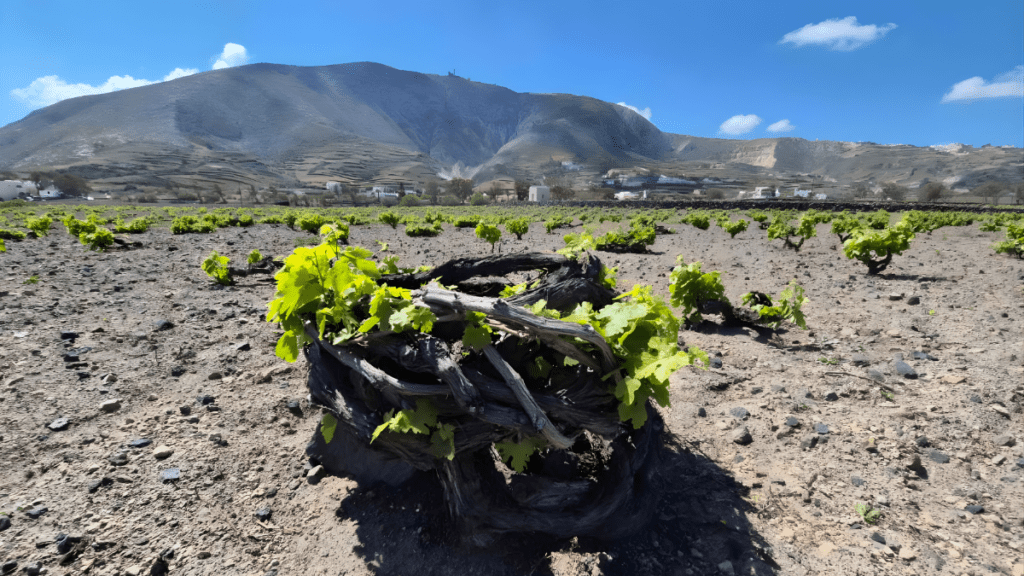
The word kouloura (κουλούρα) means ‘ring’ or ‘wreath’ in Greek, and it describes exactly what you see when you walk through a traditional Santorini vineyard. The vine is not trained upright on a trellis or stake, as in virtually every other major wine region in the world. Instead, the canes are woven year after year into a low, circular basket shape, sitting close to the ground, with the grapes hanging inside the protected interior.
This is not an aesthetic choice. It is a survival strategy refined over centuries of growing in conditions where an upright vine would be destroyed by wind or scorched by reflected heat from the volcanic rock surface.
Why This Matters for the Wine
Inside the kouloura basket, the microclimate is different from the surrounding environment. The grapes are sheltered from direct wind and from the most intense overhead sun, while still receiving reflected warmth from the volcanic ground. This creates a moderated ripening environment that preserves freshness and acidity even as sugars build — and that balance is exactly what makes great Assyrtiko possible.
The Labour of the Kouloura
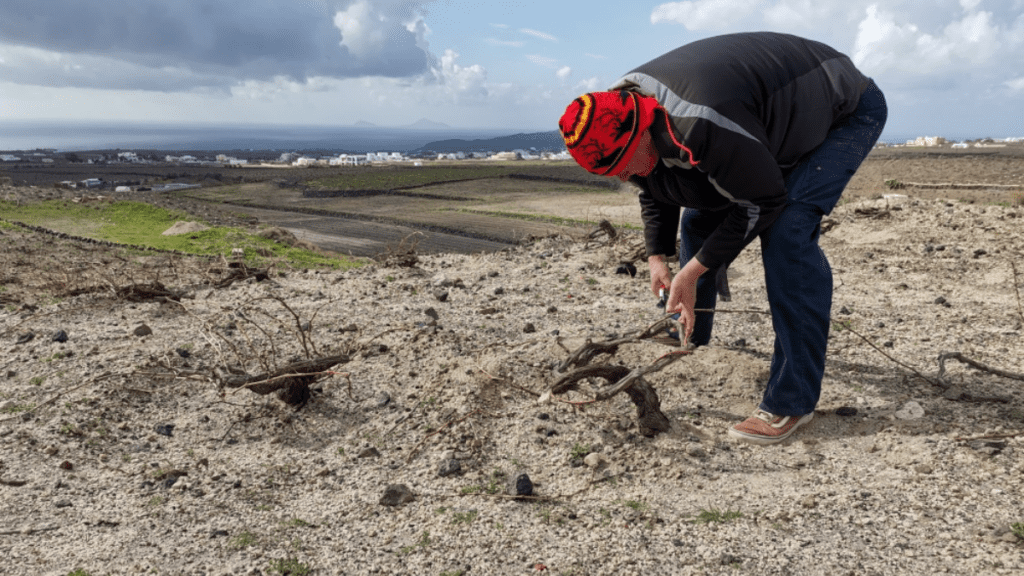
Maintaining kouloura-trained vines is physically demanding and cannot be mechanised. Each winter, skilled workers must carefully manipulate the canes — retaining older wood that provides structural integrity while weaving in new growth. The basket must remain balanced and functional. Harvest is entirely manual; tractors cannot access most Santorini vineyards, and the basket structure means that every bunch must be cut by hand, often by workers crouching low to the ground in summer heat.
This is one of several reasons why the cost of Santorini wine production significantly exceeds that of most other wine regions. The kouloura is not a quaint tradition maintained for tourism purposes. It is the only practical system that allows quality viticulture to function on this island.
The Age of the Baskets
Because the canes of a kouloura vine are never removed — only layered and added to — some of the vine’s structural wood is extraordinarily old. Individual vines across Santorini are estimated to be 70–100 years old on average, with some plots containing vines well in excess of that. The oldest vines in Santorini’s historic vineyard areas are among the most ancient in continuous productive cultivation anywhere in Europe.
Old vine material contributes to wine quality in nuanced but meaningful ways: reduced yields, deeper root penetration, and — many experienced winemakers believe — a particular kind of complexity that younger vines simply cannot replicate.
3,600
Years of volcanic soil formation
<20
Hectolitres/ha
100+
Average vine age in traditional plots
76 km²
Total PDO vineyard area on the island
Chapter 03
Ungrafted Vines and Pre-Phylloxera Identity
The late 19th century was catastrophic for European viticulture. Phylloxera vastatrix, a microscopic root-feeding louse originating from North America, swept through France, Italy, Spain, and almost every major wine region on the continent, killing millions of vines. The response was to graft European Vitis vinifera vines onto phylloxera-resistant American rootstocks — a practice that today remains universal in nearly all of the world’s wine regions.
Why Santorini Was Spared
Santorini was not. The island’s volcanic sandy soils create conditions that are essentially uninhabitable for Phylloxera. The louse requires a minimum degree of soil cohesion and moisture retention to establish itself, conditions that Santorini’s loose, porous, volcanic ash profile simply does not provide. The pest cannot survive here.
The consequence is that Santorini’s vines grow on their own original roots, as European vines did before 1870. This places Santorini in a remarkably short list of wine regions where pre-phylloxera viticulture remains intact: a list that includes only a handful of exceptional sites.
What Ungrafted Vines Express
There is genuine debate among viticulturists and winemakers about whether ungrafted vines produce qualitatively different wine from grafted plants of the same variety. What most Santorini winemakers and sommeliers agree on is that the vines here, growing on their own roots in volcanic soil, express the Assyrtiko character with a particular directness and precision. The mineral transparency of the best Santorini wines is not easily replicated by Assyrtiko grown elsewhere, even in excellent conditions. Whether that is attributable primarily to ungrafted status, to the volcanic soil, to the vine age, or to the interaction of all three remains a genuinely interesting open question in wine science.
Chapter 04
Santorini's Indigenous Grape Varieties
Santorini’s wine identity is built on a small family of indigenous varieties that have been cultivated on the island for millennia. Understanding each of these grapes — their character, their role in the blending tradition, and their expression in wine — is essential to making sense of what you encounter in a serious Santorini tasting.
White · Primary Variety
Assyrtiko
Santorini’s flagship grape and one of Greece’s most internationally celebrated white varieties. Assyrtiko is defined by exceptional natural acidity (rare in a Mediterranean climate), concentrated citrus and stone fruit character, and a pronounced mineral salinity derived from the volcanic soil. It ages with distinction, developing notes of petrol, lanolin, and toasted almonds over time — and retains its structural acidity even at full ripeness, which is rare for any warm-climate white grape.
White · Blending Variety
Athiri
A softer, more aromatic white variety found throughout the Aegean. In Santorini, Athiri contributes floral and herbaceous character to blends, softening Assyrtiko’s austere edge. Historically planted in the vineyard alongside Assyrtiko in what viticulturists call a field blend, Athiri adds aromatic complexity and rounds texture. It rarely appears as a varietal wine on Santorini — its strength lies in the supporting role.
White · Blending Variety
Aidani
The most elegant of the island’s indigenous white varieties, Aidani is prized for its floral aromatics — orange blossom, white peach, and jasmine — and its lower natural acidity relative to Assyrtiko. In blends, Aidani introduces a delicate aromatic dimension that broadens the sensory experience without adding weight. It is also an important component in Vinsanto, where its aromatics concentrate beautifully during the sun-drying process.
Red · Rare Indigenous
Mavrotragano
A red variety of extraordinary potential, Mavrotragano was nearly lost to obscurity during the 20th century when high-yielding varieties replaced it across the island. Its revival, led by a small number of committed producers, has produced some of the most compelling red wines in Greece: deeply coloured, intensely tannic, with dark cherry, spice, and remarkable ageing structure. Mavrotragano at its best demonstrates that Santorini is not exclusively a white wine island — it is a volcanic terroir that expresses power in any colour.
Red · Cycladic Variety
Mandilaria
Mandilaria is found across the Cyclades and contributes a deep, almost inky colour and high tannin content to Santorini red blends. On its own, it can appear austere — but in the hands of skilled producers who manage extraction carefully, it adds structural depth and ageing potential to wines that include Mavrotragano. The variety is also used in small quantities in Vinsanto production.
Historical Context
Mandilaria
In traditional Santorini vineyards, multiple varieties were planted together in the same plot and harvested simultaneously — a practice known as a field blend. This interplanting was not casual; it was a deliberate risk-management and quality strategy developed over generations. Different varieties ripen at slightly different times, meaning that in any given year, the composite harvest is more balanced than a mono-varietal block could achieve.
Chapter 05
Santorini Winemaking: From Volcanic Vineyard to Glass
Understanding the winemaking process in Santorini requires appreciating that every decision in the cellar is shaped by the extreme conditions of the vineyard. The grapes that arrive at harvest are already unusual: concentrated from low yields, high in acidity, loaded with mineral character from the volcanic soil. The winemaker’s task is to receive those grapes with as much respect as possible and translate their qualities into wine with minimal interference — or, in the case of the island’s more ambitious producers, to deliberately develop that potential through specific cellar techniques.

Harvest: Earlier Than Anywhere in Europe
Santorini's harvest typically occurs in late July to early August — weeks earlier than most major European wine regions. The combination of volcanic heat absorption, intense sunlight, and dry conditions accelerates sugar accumulation in the grapes. Producers who prioritise freshness and acidity in their wines tend to harvest on the early side, often before full phenolic maturity, to preserve the natural acidity that defines the PDO style. Everything is hand-picked; the terrain, the kouloura vine structure, and the small scale of most plots make mechanical harvesting impossible.

Pressing and Settling
For white wines, the harvested grapes undergo gentle pressing to extract juice while minimising extraction of phenolic compounds from the skins. The resulting must is typically settled (allowed to clarify by gravity) before fermentation begins. Many producers now use pneumatic presses and temperature-controlled settling tanks to preserve the aromatic delicacy of the juice at this stage.

Fermentation: Steel or Oak
The majority of standard PDO Santorini Assyrtiko is fermented in temperature-controlled stainless steel, which preserves primary fruit character, acidity, and the crisp mineral profile most associated with the variety. For Nykteri production, partial or full fermentation in oak barrels adds textural richness and aromatic complexity — contributing the toasted almond, vanilla, and stone fruit notes characteristic of the style. A small number of producers are also exploring amphorae fermentation as a reference to ancient Greek winemaking practice.

Ageing: Fresh Styles vs. Oxidative Complexity
Dry white PDO Santorini in the fresh style is typically bottled relatively early to preserve aromatic vibrancy. Nykteri, by PDO regulation, must spend a minimum period in oak barrels. Vinsanto, the island's exceptional sweet wine, undergoes the most complex ageing of all: after the sun-drying process concentrates the grapes, fermentation produces a wine of great natural sweetness that is then aged in oak for a minimum of two years (for basic Vinsanto) and up to decades for reserve expressions.

Vinsanto: The Sun-Dried Tradition
The production of Vinsanto is Santorini's most labour-intensive and historically distinctive winemaking practice. After harvest, selected grapes — primarily Assyrtiko with Athiri and Aidani — are spread on the volcanic ground to raisin (dry) under the August sun for a period of 10–14 days. The drying concentrates sugars, acids, and flavour compounds dramatically. The resulting must ferments slowly to a naturally sweet wine of extraordinary richness. Vinsanto's name is believed to derive from Vino di Santorini, referencing the historical trade of this wine to Venice and beyond during the medieval period.
Chapter 05
PDO Santorini: Protected Wine Styles and Classification
The Santorini PDO (Protected Designation of Origin) is the regulatory framework that defines the standards required for wines to carry the Santorini designation. For wine enthusiasts, understanding the PDO structure is the clearest way to navigate the island’s wine landscape.
Dry White PDO Santorini
The primary style and by far the most commercially significant. Must be made from a minimum of 85% Assyrtiko, with the remainder drawn from Athiri and Aidani. Fermented typically in stainless steel, resulting in wines with high acidity, citrus and stone fruit character, and the volcanic mineral signature associated with the island. The best examples age remarkably well. A 10-year-old Assyrtiko from a respected producer gains complexity without losing its structural freshness.
Nykteri PDO Santorini
A dry white wine made predominantly from Assyrtiko and required by PDO regulations to undergo barrel aging. Historically, Nykteri was harvested and pressed during the night (nykteri = night) to avoid the oxidizing effects of summer heat. Modern Nykteri maintains the oxidative character through barrel maturation: richer in texture than standard Assyrtiko, with notes of toasted almonds, beeswax, white peach, and a long saline finish. For collectors, well-made Nykteri from top producers represents some of Greece’s most age-worthy white wine.
Vinsanto PDO Santorini
Santorini’s legendary sweet wine, made from sun-dried indigenous varieties and aged in oak. PDO requirements specify a minimum of 51% Assyrtiko, with Athiri and Aidani permitted. The resulting wine is amber to deep mahogany in color, with extraordinary concentration: dried apricot, fig jam, walnut, caramel, coffee, and a mineral backbone that prevents the sweetness from becoming cloying. Vinsanto is among the most historically documented wines in Greece and one of the most distinctive naturally sweet wines in Europe.
For Wine Enthusiasts: The Ageing Question
Santorini Assyrtiko is one of the white wines of the world that genuinely rewards cellaring. The combination of high natural acidity, volcanic mineral structure, and low yields creates a wine architecture that evolves gracefully. At 5 years, expect increasing complexity and depth alongside the primary citrus. At 10+ years, well-stored bottles develop into wines of real weight, with reductive notes, stone fruit concentration, and that unchanging saline minerality. Nykteri and Vinsanto age even more slowly and can develop for decades.
Chapter 07
A Sommelier's Guide to Tasting Santorini Wine
Tasting Santorini wine with full attention — rather than simply drinking it — reveals a set of characteristics that are genuinely unlike those of any other white wine region. The following is a framework for approaching a structured Santorini tasting as a wine enthusiast.
Colour and Appearance
Young dry Santorini Assyrtiko is typically pale yellow with green reflections, brilliant and clean in the glass. As the wine ages, the colour deepens toward gold. Nykteri may show a more pronounced gold even when young. Vinsanto presents as deep amber to tawny — the colour itself signals years of oxidative development.
Nose: The Mineral Signature
The most immediately distinctive element of Santorini Assyrtiko on the nose is a saline, almost iodine-like mineral note that most wine professionals associate with volcanic soil expression. Beyond this, look for citrus (lemon zest, grapefruit), green apple, white stone fruit (nectarine, unripe peach), and in older wines, a reductive character that some describe as petrol or lanolin — similar to the aged Riesling notes familiar to German wine enthusiasts. Athiri and Aidani-dominant blends will show more aromatic florality.
Palate: Structure, Acidity, and Length
Santorini Assyrtiko’s defining palate characteristic is its acidity — pronounced, mouth-filling, and precise rather than sharp. This acidity is the backbone that carries the wine through ageing and that makes it such an exceptional food companion. Body is medium to medium-full, often with a slight textural grip from the volcanic mineral content. The finish is long and persistently mineral, frequently returning to that saline signature that opened on the nose.
Food Pairing: Thinking Through the Island
The island’s food traditions and its wine have evolved together over centuries, and the pairing logic reflects that. Fresh seafood — particularly grilled octopus, raw sea urchin, and simply dressed fish — is the natural partner for young dry Assyrtiko. The wine’s acidity cuts through brine and oil beautifully. Aged Nykteri works alongside richer preparations: cured fish, hard cheeses (including Santorini’s own chlorotyri and fava-based preparations), and dishes with some toasted or roasted character. Vinsanto is traditionally served with the island’s almond-based pastries and dried fruit desserts — or simply contemplated on its own.
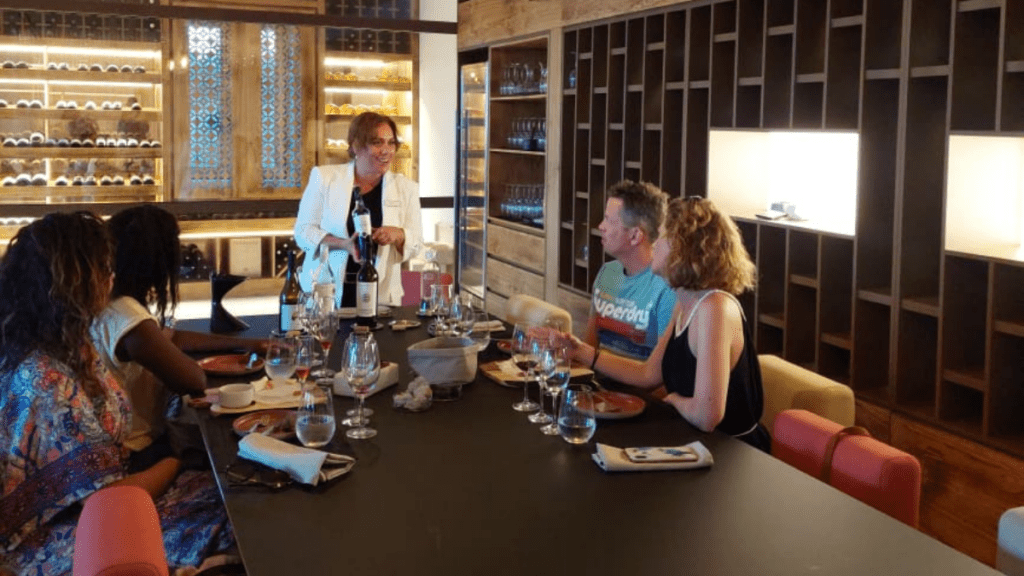
Guided Wine Experiences
Experience What You've Just Read About
Every Terroir Santorini experience begins in the vineyard and ends with a glass that makes sense. Led by certified sommeliers who live on the island year-round.


Frequently Asked Questions
Everything You've Wondered About Santorini Wine
Answers from our sommeliers to the questions we hear most often in the vineyard, at the tasting table, and before guests book their first wine tour in Santorini.
What grape is Santorini most famous for?
Santorini is most celebrated for Assyrtiko, an indigenous white variety that produces wines of extraordinary acidity, volcanic mineral depth, and impressive ageing potential. Grown in volcanic soils under extreme climatic conditions, Assyrtiko expresses a salinity and citrus-driven precision unlike any other white grape in the world. It accounts for the majority of Santorini’s PDO white wine production and has earned the island serious international recognition among sommeliers and collectors.
What is the kouloura vine training system?
Kouloura (meaning ‘basket’ or ‘ring’ in Greek) is Santorini’s ancient and unique vine-training method, in which growers weave the vine canes into a low, circular basket shape close to the volcanic ground. This technique protects the grapes from the island’s powerful meltemi winds and from the most intense Aegean sun. The grapes hang inside the basket’s protected interior, ripening in a more moderated microclimate. The kouloura cannot be mechanised and requires skilled hand-management every winter and harvest. It is one of the oldest continuously practiced agricultural traditions in Europe and is directly responsible for the concentration and aromatic balance found in traditional Santorini wines.
Why are Santorini vines ungrafted?
Santorini is among the very few wine regions in the world where vines grow on their own original roots — ungrafted. This is because the island’s volcanic, sandy soils are inhospitable to Phylloxera vastatrix, the root louse that devastated European vineyards in the 19th century. The loose, porous composition of volcanic ash and pumice prevents the pest from establishing itself. As a result, Santorini’s vines have never needed to be grafted onto American rootstocks, and many individual plants are estimated to be over 100 years old, with some potentially far older. This pre-phylloxera status places Santorini in an extraordinarily short list of historically significant wine regions.
What is PDO Santorini wine?
PDO Santorini (Protected Designation of Origin) is the top classification for wines produced on the island. To qualify, wines must come from grapes grown within the defined PDO zone, made primarily from Assyrtiko (minimum 75% for dry white PDO Santorini), and produced according to established rules. The PDO designation covers three main styles: dry white Santorini, the oak-aged Nykteri, and the sweet sun-dried Vinsanto. PDO classification protects both quality standards and the geographic identity that makes Santorini wine distinct from other Greek wines made with similar grape varieties.
What is Nykteri and how is it different from regular Assyrtiko?
Nykteri is Santorini’s dry, oak-aged white wine style, distinct from the fresh stainless-steel Assyrtiko most visitors first encounter. Its name comes from the Greek word for ‘night’, referencing the historical tradition of harvesting and pressing grapes after dark to preserve aromatics in the intense summer heat. Nykteri undergoes barrel ageing, which produces a richer, more textural wine: expect toasted almonds, beeswax, stone fruit, and a long saline finish rather than the fresh citrus directness of young Assyrtiko. For wine enthusiasts accustomed to white Burgundy or aged white Rioja, Nykteri offers a reference point — though it remains distinctly Santorinian in its mineral backbone.
What is Vinsanto and how is it made?
Vinsanto is Santorini’s legendary naturally sweet wine, produced from grapes that are sun-dried on the volcanic ground after harvest. Primarily Assyrtiko, Athiri, and Aidani are spread out for 10–14 days in the August heat, concentrating sugars and flavour compounds dramatically. The resulting must ferments slowly, producing a wine of great natural sweetness that is then aged in oak barrels for a minimum of two years (and in the best examples, for much longer). The resulting wine is amber to deep mahogany in colour, with notes of dried apricot, fig, walnut, caramel, and a mineral thread that prevents the sweetness from becoming heavy. Vinsanto has been documented in historical trade records stretching back centuries, and represents one of the most historically significant sweet wines in Europe.
How does volcanic soil affect the taste of Santorini wine?
Santorini’s soils — composed of volcanic ash, pumice, lava-derived minerals, and sand — are extremely poor in nutrients and organic matter. This stresses the vine and forces it to concentrate energy into the fruit rather than vegetative growth, producing very low natural yields and grapes with intense flavour concentration. The mineral composition of the soil — particularly the presence of silica, iron compounds, and trace volcanic minerals — is widely believed by experienced tasters and winemakers to contribute to the distinctive saline, almost iodine-like mineral signature found in the best Santorini Assyrtiko. Whether this is strictly a soil-to-wine mineral transfer or a combination of physiological vine stress and soil expression is debated in viticulture science — but the taste signature is consistent and recognisable.
Why is Santorini wine so expensive compared to other Greek wines?
Several structural factors make Santorini wine among the most expensive in Greece. Vineyard yields are extraordinarily low — often below 15–20 hectolitres per hectare, compared to European averages of 50–70 hl/ha. All harvesting is done entirely by hand; tractors cannot access most plots and the kouloura vine structure requires individual cluster-by-cluster picking. The island receives minimal rainfall and has no rivers, so vines cannot be irrigated and must develop deep root systems. Arable vineyard land on Santorini is also under significant real estate pressure from the tourism economy. Each of these factors adds to the cost of production — and that cost is reflected in the bottle price, which for premium PDO Santorini from top producers is entirely justified by the wine’s quality and rarity.
What is the best time to visit Santorini for wine tourism?
The main wine tourism season runs from May to October. For the optimal balance of mild temperatures, manageable crowds, and winery access, May–June and September–October are the most rewarding periods. Harvest season — typically late July to early August — is an especially vivid time to visit, when wineries are in full production and the kouloura vineyards carry their full complement of ripening fruit. Terroir Santorini operates sommelier-led wine experiences throughout the main season, with both daytime and sunset departures available. We recommend booking in advance, particularly for July and August.
What is the difference between a Santorini wine tour and a winery tour?
A winery tour typically involves a visit to a winery facility — production areas, barrel rooms, and tasting rooms — where wines are presented in a structured format. A wine tour is broader: it may include a vineyard walk to understand viticulture and grape varieties, multiple winery stops with sommelier-guided tastings, food pairings, and a fuller educational experience. Terroir Santorini’s experiences are wine tours in this fuller sense — they begin in a traditional kouloura vineyard before moving to carefully selected wineries, giving guests the complete journey from vine to glass. The vineyard visit, we find, is the element that transforms wine tasting from a sensory exercise into genuine understanding.
Can I visit Santorini wineries independently, or is a guided tour better?
Independent winery visits are possible at several of the island’s larger producers, who have visitor centres open to walk-ins during the main season. For wine enthusiasts who want to go deeper — to understand the kouloura vineyard system in context, to taste across multiple estates with expert commentary, to compare the stylistic differences between producers, and to connect the landscape to what is in the glass — a sommelier-led tour provides a substantially richer experience. It is the difference between reading a wine list and understanding how to read one. Our experiences are designed for guests who already have some wine knowledge and want to use it actively throughout the day.
